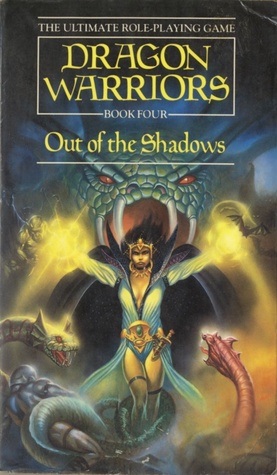
After the first trilogy of Dragon Warriors books were released (apparently at the same time), another three were published, one at a time. Again, two (including this one) by Dave Morris, with Oliver Johnson doing the other. Apparently they didn't publish as many copies, though, so the seem to have made less of an impact.
Because of this, while I had a copy, and my high school library, IIRC, had a copy, and my high school gaming group were playing either Dragon Warriors or a homebrew that crossed Dragon Warriors, Fighting Fantasy and Magic the Gathering with rules that changed every game, it wasn't until sometime later that I picked up book 6 and even knew there were another three books out there. Looking up Dragon Warriors online, one of the first people I found who'd written about it had much the same to say. Ok, maybe their gaming group didn't have anyone let someone else play for them while they were absent and come back to discover their character's penis was missing, that could have just been the people I knew during high school.
Anyway, the first trilogy works as a self-contained game. First two books of the first trilogy, rather, the third book is nice, but doesn't have anything you need, and no additional rules that you'd actually want to use. The second trilogy feels a bit tacked on as an afterthought. It does avoid trying to hammer shiny new square rules into a system that was designed as a round hole, though, expanding rather than invalidating.
Chapter One
The first thing to come out of the shadows is the new Profession of Assassin. There's a few problems with this one. It does say that Assassins are rare amongst adventurers, that they don't get on with Knights, that the GM can say you can't play one. It also says that Assassins can get up to all the same stuff other adventurers do, and don't have to go around assassinating people. Ok, fine, you do need that in order to play the game (which might be considered important), but why call them an Assassin then?
Given that they are about fancy martial arts, unarmed combat, throwing stars, smoke bombs and flash pellets, you might want to call them Ninjas. Now, sure, the word "Ninja" doesn't really fit into the Medieval England setting Dave Morris was going for, but then do you want something exactly the same as a Ninja but with a different name?
Now, of course, this is something that some players are going to want, some GMs will allow, and some Knights will have to put up with. So, if you play as an Assassin, what do you get to do?
You get to use 13 special abilities. When you punch something, you don't get the (d3,2) unarmed combat attack everyone else uses, you do (d6, 3), the same as a staff. Or rather, the same as when everyone else uses a staff, when you use a staff, sword, shortsword, dagger or throwing spike/star, you get +1 to your armour bypass. You can throw three throwing spikes as one action. Those aren't three abilities, those are all part your first one, "Combat Techniques".
You can fall 6m without any damage, and can jump anything less than 3m tall like you are world high-jump record holder Javier Sotomayor, if Javier Sotomayor jumped 3m for his record instead of 2.45m. Again, not two separate abilities, just two parts of the "Climbing" ability, and that's without mentioning the climbing.
If you sneak up on someone and attack them, you don't just surprise them like everyone else does, you can extra special surprise them if you outrank them.
OTOH, one of your abilities is "has really good Stealth and Perception scores" (and anyone who is an elf gets the same as you), but you still get a lot of fancy skills other classes don't. Now, in fairness, this book also includes some skills for other Professions. If you exclude "only Knight and Barbarians can ride Warhorses" as a skill, before this book Barbarians got all of one special ability. With the rules in this book, that number is now doubled. For Barbarians of 8th or higher Rank. Because they get a new variant of the rule they had before.
Now, it could certainly be argued that Assassins need lots of fancy tricks, they don't use the heavy armour of Knights or Barbarians (they can use Ring Mail without combat penalties, but they take Stealth penalties for anything more than the Hardened Leather they start with). They don't get the big spell list of the Sorcerers, or the smaller spell lists of the Mystic, though they do share some conceptual space with the later and get some similar magicky powers. Still look overpowered to me.
Another issue Assassins have is the use of poisons. Poisons were introduced as things some monsters used in the first book, and as something Sorcerers could make in the second. Only now with Assassins you could reasonably expect PCs to use poisons. They even get to start making them from Rank 1, though they've got the same odds per Rank of getting it right (a percentage of your Rank times 10) so you'd probably not bother just yet.
But, you'd expect that at some point an Assassin likely will use poison. I'm reminded of something Gary Gygax wrote (a bit of rummaging and I see it was in AD&D Player's Handbook, 1978 p107) about how if you give players poison for their weapons, they'll use it to easily kill the dragon instead of fighting it and it'd ruin the challenge. But, ok, this is Dave Morris's game, not Gary Gygax's, players can use poisons on their weapons. Well, not so much against dragons, unless they are also magical, as you need magic weapons to hurt dragons. Don't know if that applies to poisons as well. Do poisons work on magical creatures? Fungus Men? Giant Beetle? Doesn't say it doesn't work, so unless you're going to houserule it, I suppose it works on Skeletons.
Ok, fine, we're using poisons, and you can decide whether or not it works on Mummies, but probably should work on, say, Ogres. Just roll over their Strength on 3d6 (for Normal Poisons) and they die. Which would make it really useful if they gave Strength stats for either of those monsters. Or any monsters apart from, IIRC, Vampires and Zombies. Anytime you use poison against anyone or anything that isn't a fellow PC and/or a Vampire or a Zombie, it's roll 3d6 and comparable it against some number you won't have. Any creature not specified (which is more or less any creature minus, again, Vampires and Zombies) rolls 3d6 for their Reflexes stats (which is bad for other reasons), you could do the same for Strength and then whether or not your 3d6 is higher than their 3d6 isn't quite a coin toss, but close. Either this never came up for Dave Morris, or there was a rule he forgot to put in the rulebook.