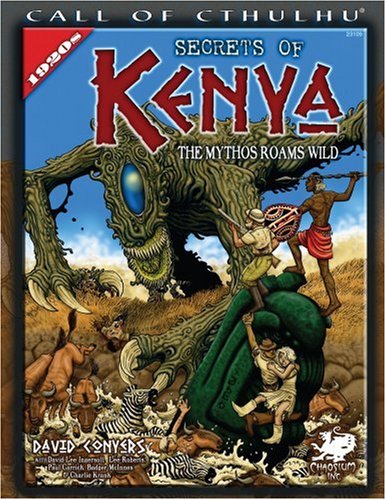
Chapter 9: Savage Land
Okay, we've had one adventure that's overly ambitious and one that's rubbish, and now we have...this.
A safari hunter loses his wife and two daughters in a savage attack by a wild animal. Clues left at the scene of death suggest the involvement of the sinister cult of African Leopard-Men.
This is actually a good premise. Realistically, if you're playing CoC, a certain amount of your "adventures" should be fucking with the players, with no real Mythos goings-on at all, to lure them into a false sense of security and give them a chance to build up and show off their other skills. That doesn't actually happen a lot, but then in CoC you're not actually expected to improve your character significantly.
Anyway, the backstory for this is adventure is that the leader of a local Leopard-Men cult became inducted into the dual-worship of Tsathoggua and Cthulhu (T&C is something of an African speciality, and I have no idea why, it just is, apparently). He's overstepped himself in attacking an English farm and taking two white women prisoner, so now the PCs are called in to investigate...
 This is quite literally Great White Hunter: The Game
Unlike the other scenarios, this one actually has a hook for African characters (their tribes have been attacked by the Leopard-Men too).
Cue various rolls - Library Use won't help you
much here, but it isn't useless - and there's a funeral held for the missing white women (with empty coffins). Some of the sources suggested for the Leopard-Men cult include
Tarzan and the eopard Men and
TinTin au Congo.
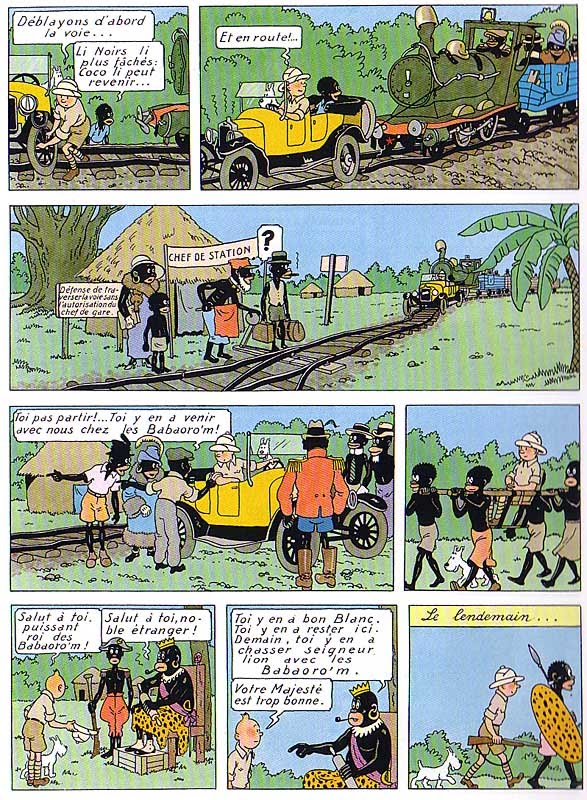
Eventually, the PCs should get enough clues to go on safari for the source of the attacks/the missing white women, and meet some friendly Maasai, who fill them in on some of the details that weren't in the newspaper archives and comic books in Nairobi (this involves a sidequest to buy some land for the Maasai to live on, which of course no-one will sell the PCs if they advertise that they're just going to give it to some black people. I know this is correct for the period, but it is still very tiresome.)
Eventually the PCs go on
another safari to find the source of the Leopard-Men, and their car breaks down (next time, take camels), their camp is sacked while they're away, and the PCs start getting stalked across the savannah by hyenas, jackals, and lions.
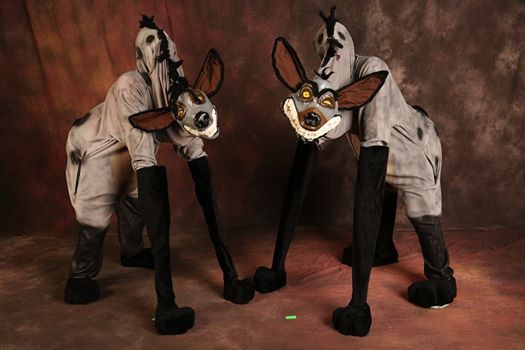
If the PCs survive, they eventually stumble across the Leopard Men Village, which is in the valley of the crescent...no, fucking seriously...along with the twin shrine of Clulu and Tsadogwa. At this point, the game takes a turn. They PCs should either rescue the girls or genocide the village - both if they have the firepower - or else call in the King's rifles.
Instead, PCs are presumed to have been captured, and are hung up while the head Leopard-Man priest decides to try and turn them to the worship of the Great Old Ones. Anyone that agrees gets to be subject to the spell "Awaken the Beast," which turns them into an African animal.
 Seriously, this is your sales pitch.
If you can't rescue the girls by the full moon, people get sacrificed, turned into animals, engage in a cannibalistic feast, a formless spawn of the Great Old Ones appears, and you have to wait 1d20 hours for the next train. Other than that it's gravy.
Chapter 10: Wooden Death
The Fungi from Yuggoth discover a strange alien site in the back-country of Kenya Proving too difficult to investigate on their own, they summon help through trickery, deceit, and an odd surgical procedure.
This is loosely based on/inspired by Donald Wandrei's "The Tree-Men of M'bwa." Which isn't exactly the most obscure classic Mythos story, but it's getting up there. Also, these aren't the same African tree-spirits that show up in
Green and Pleasant Land because...um...presumably Chaosium forgot about them or didn't think they had the rights, probably.
The Mi-Go are a weird part of Cthulhu Mythos lore. They only really show up in one late Lovecraft story - "The Whisperer in Darkness" - and later writers add their own takes on them. Chaosium likes to use them as a dumping ground for when you want a sufficiently advanced alien civilization doing weird shit, so their goals, motivations, methods, and overall technology level are wildly inconsistent between products, except when Chaosium decides to keep their wondrous gear as minimal as possible. Does that make sense? Like, individual authors tend to make up crap for the Mi-Go, and Chaosium seems allergic to extrapolate from this or to explore any of the implications of any of it, so you've got a relatively small amount of material that gets reprinted a lot and doesn't make a lot of sense.
I guess the equivalent is how in D&D you can just throw a mindflayer into any old adventure, and in one adventure they have this wondrous piece of gear which is never ever mentioned in any other adventure or anything ever again until it's reprinted, verbatim, with no extra material on how it fits into their culture or anything, in some splatbook that collects all the mindflayer shit. And that should lead to something like the
Illithiad or
Lords of Madness but...doesn't. Because Chaosium never wants to just do a Mi-Go book to keep their setting consistent.
Anyway, beyond the Mountains of the Moon (which are actually in Uganda, but whatever) is a crater where the Great Old One called the Red Flux crash-landed in a metal space ship. It's zombie servant M'bwa captures wandering humans (and, apparently, Mi-Go) and turns them into tree-men. Like ya do.

The Mi-Go started out by stealing cattle and using them to experiment with bypassing M'bwa, but that didn't work. So they've moved on to humans. Normally, this is the point in Shadowrun where Mr. Johnson would hire some mercs out of Nairobi, but this is CoC, so instead the investigators get a letter from Mr. Cloud, promising money to investigate, accompanied by a living wooden hand with roots - presumably, this is enough to get the PCs to bite.
Blah blah Library Use, journey to the trading post, through a dying village (with reports of UFO sightings!) to another trading post, where they meet Mr. Cloud - who tells them more of the story and shows them some more evidence of weird wooden body parts, and tries to get them to go investigate the crater. Option B is to kill McCloud and loot his corpse.
If investigators do overpower Mr. Cloud or kill him and check his body, a Spot Hidden identifies hairline scars on the back of his skull. If Mr. Cloud's skull is cut open and examined (costing 0/1D3 Sanity to perform this bloody task(, they find an odd structure at the back of his brain, a band of pliable grey-orange substance covered with odd lines and grooves. It joins to the spinal cord. Seeing this costs 0/1D3 Sanity points. The item is a form of neural implant control placed there by the mi-go, but investigators in the 1920's or 1930's would have no idea what this device could do since humans have not invented computers yet, the closest human analogy to the device in the skull.
Wouldn't it be
great if the Mi-Go used this implant before? Or...later? Ever? With any other agent? 'cause they don't. Bah, humfuck.

Investigators may well be captured by the Mi-Go if they oppose Mr. White (this is getting repetitive; every single fucking adventure so far is a railroad.) The Mi-Go put them back together (literally: if your body is too damaged, the Mi-Go just pop your brain into somebody else's body.) The Mi-Go then get the PCs to investigate basically by blackmailing them: they remove the character's stomachs (replacing them with an implant, the Mi-Go Detachable Stomach. Which, unknown to them, and as a special fuck-you to the players, will eventually kill their characters in the long run. But of course there is no "long run" in CoC), holding them for ransom. Nothing like an incentive!

Anyway, they reprint some Mi-Go tech rules and spells (Contact Human is a useful one, pity humans can't learn it). Mr. Cloud, if he didn't survive the PCs, gets his brain put into a Ashanti man's body to tag along and help out. Then it's CHOO-CHOO and into the Valley of the Red Flux.
I should pout out that M'bwa is described as "Zombie Lesser Servant of the God of the Red Flux," which despite his impressive stats (Str 27, Con 33, HP 22, no damage from impaling weapons and all others do half damage) means that he should be vulnerable to anti-zombie spells, some of which are actually described in this book. None of them actually appear in this adventure, however, so there's a good chance the investigators might be SOL.
Provided they make it past M'bwa into the center of the valley, the "craft" turns out to be a gate to the world of the Red Flux, which the PCs get to investigate - y'know, if they're stupid or suicidal or if the Mi-Go are holding their stomachs hostage.
There are signs people have been here before - including a helpful sign in English "Do Not Gaze into the Pit Ahead!" - this is good, because looking at the pool is grounds for a 0/1 SAN test and then their bodies melt and they emerge from the pool rebuilt - which gets rid of the Mi-Go implant! - but which costs them 1d6/1d20 SAN and they need to pass a Luck roll to be remade without missing parts - and if they ever fumble a Luck roll in the future, they unravel again, this time permanently.
The mi-go will be most interested in obtaining samples of the black pool liquid to study.
Anyway, once they're done vacationing in an alien world, the PCs can go back to their own world, and submit a report to the Mi-Go, who trade the PCs back their stomachs in exchange for any objects of interest. The PCs aren't told how to hook their stomachs back up, they have to figure that out themselves. Given the SAN losses for this adventure, you'll be lucky if one PC doesn't grab all of them and go all Frinkenstein.
 Appendix A: Timeline of British East Africa
What it says on the tin. Boring, no Mythos references.
Appendix B: Cthulhu Afrikus
Some other Mythos sites in Africa, based on various stories. The Broken Columns of Geph in Liberia, Cairo in Egypt (no, no mention of
The Cairo Guidebook), Canyons of the Ituri-kendi in the Belgian Congo (not mentioned in
Secrets of the Congo), the Cult of the Floating Horror in Nigeria (which spawned a Haitian voodoo cult, somehow), G'harne in Mali, the Grey City in the Belgian Congo ("Arthur Jermyn"), Great Zimbabwe in Southern Rhodesia...
 Lovecraft subscribed to funny ideas about Great Zimbabwe being founded by white people, because that theory appealed to his prejudices.
...Jebel Barkal in the Sudan (even I haven't heard of that one), King Solomon's Mines in Angola (Allan Quartermain), Kish in Egypt, the Mountain of the Black Wind in Kenya (wait, this is the Kenya book - why didn't they go into more detail about it here? Because it would basically be a reprint of the material in
Masks of Nyarlathotep), Nyargo in the Belgian Congo, the Pyramids and the catacombs and the Sphinx of Giza in Egypt...
...and so on and so forth. They even had a paragraph on the Valley of the Red Flux, and we just had an entire fucking
adventure dedicated to that, which makes me wonder if this appendix was written for something else and just sort of fucking grafted on to this book like a hideous parasite.
Appendix C: Bibliography
I have most of the mythos sources, except for a bunch of Conyers' fan-articles which were printed in various Mythos magazines in the early 2000s, which explains a good bit. He even cites
Mysteries of Morocco, which is impressive for how little the two books share in actual content. I mean, they
do share content, but it's a one-way street as far as trying to build connections, William Jones wasn't trying to forge an "African Mythos" or ties to Kenya or anything, but Conyers borrowed a few things.
In place of an index, they did this thing called an
Expanded Contents - it is what you might think, somebody went into a word document and had them list every heard, so you can get 3-6 entries for the same fucking page (it even includes all the illustrations). The back of the book is filled up with maps and player handouts and...that's the book.
How bad was this book? By Call of Cthulhu standards, you have to understand, even with the crappy artwork this could be considered an exceptional product. There are plenty of CoC books that make zero effort to connect to any other CoC product, plenty of CoC books that leave lots of stuff out or just ignore whatever came before (like
Secrets of Tibet ignored
Secrets of Japan and
Mysteries of the Raj). It also addresses stuff that CoC is normally bad about: the rampant racism of a past era. Now, I don't particularly like how Conyers did that (Great White Hunter archetype? Really?), but he did it, and that's some progress compared to other Chaosium books. And Conyers emphasized the Mythos elements in Africa and in the region in general, which is something a lot of CoC writers tend to forget, focusing as they do on simulation rather than role-play potential.
Is it a good book? Well...I'm not even quite sure it's at the level of the
Native American Nation books for Shadowrun. You've got a similar level of combination of kinda-uncomfortable race stuff and boring demographics and where-to-buy-such-and-such and really quite fucking annoying adventures. It is, without a doubt, as close as you're going to get to an
Africa sourcebook for CoC...and I think Conyers recognized that...but Africa in the Mythos is such an afterthought, that the Mythos stuff doesn't really hang together very well. Which isn't entirely Conyers fault, since he was basing a lot of it on the
Masks of Nyarlathotep campaign, and that is...well, I think it's rubbish, but fans of Call of Cthulhu might disagree.
Really, these aren't flaws restricted to Africa. They're symptomatic to basically any part of the Mythos not directly mentioned by Lovecraft and/or his contemporaries and followers. Mythos stories don't usually translate directly into good adventures for investigators, and the antagonists, clues, and challenges in those stories don't often translate over well. Kenya suffers a bit more than most in that like a lot of Africa, most of its history is unrecorded - and the Mythos really works best when there's a central text or two that can serve as a reference and key to various things. Lacking any actual
African Mythos texts, you're down to what a bunch of non-African people wrote about the Mythos in Africa at some point. Which is okay, but it still has you approaching the continent from an outsider perspective, and it doesn't really mesh the Mythos with the local customs or religion at all.
I mean, when the Esoteric Order of Dagon set up shop in Innsmouth, they displaced the Freemasons, and then intimidated the churches out. How does that work in Africa? I have no idea. Africa is a big place. How does that work in
Kenya? Even after reading this book, I have no idea. And that's a bit sad. It's not that you need Deep Ones in Kenya, but I'd like the option, maybe.
So it's...well, if you take it compared to a contemporary 2007 product, it looks like amateur-hour bullshit. This was one guy mostly working on his own, and it probably took him a year to research and write and cobble together from his fan-articles. But compared to
Secrets of Morocco or
Secrets of the Congo, it's a refined, intelligent, and even ballsy piece of work. But being the shiniest turd on the shitpile is not something to aspire to, and honestly this book left me bored a lot of the time. There's not even much to
steal from it, because so much of it has been reproduced from somewhere else.